Song of the Week for June 17, 2018

This might go up a little late. New job is messing with my usual schedule. This’ll be a quick one.

Song of the Week: Legend (ft. Backchat) by Jaroslav Beck

This song is very upbeat. If you don’t like rap, you might not like this song, but even without the words, the backing music is great. But that’s not the reason why I like this song.

This song is from the soundtrack for the game Beat Saber, which can best be described as Virtual Reality Lightsaber Dance Dance Revolution. Take a look at some well-edited gameplay. This game looks incredibly fun, and a good workout. The trick is that you need virtual reality gear, which isn’t cheap. I don’t think I want a DDR machine that badly.

Sorry again for the short post. I’ll come up with something big for Tuesday.

What Happens Now?

Well, I have a job now. A real job, that lets me work more than 7 hours a week. But what does this mean for my blog posts?

I might not have time to go places and try things anymore. Working during the day gets in the way of places being open. But that’s not to say that I won’t be trying new things. It just won’t be a guaranteed weekly occurrence.

In the meantime, this spot will fluctuate. Friday will still be dedicated to exploring my existing interests, and if I don’t have something to write about on Tuesday, I’ll just have to explore those interests on Tuesday as well.

And the blog certainly isn’t going anywhere, if for no other reason than I’ve payed up-front for a year. Check back on Friday for…I haven’t written that one yet. Back to video games, probably.

Song of the Week for June 10, 2018

Well, after last week’s feels festival, I figured I should bring it back to something less liable to make me and my readers cry. So of course, we’re going back to Two Steps From Hell, and song number 2 on my list of music video concepts.

Song of the Week: Victory by Two Steps From Hell

I first heard this song while I was deep in a Dungeons and Dragons-type game called Exalted. In it, characters have amazing, mythical powers, and one of the other players was playing as a blacksmith who could create mundane items at an incredible rate, and incredible items without much effort. This song is the story of one such incredible item.

For the first 30 seconds, we’re doing establishing shots. The smith is in their home, making sketches, planning it out. Eventually, they take the sketches from their home to the forge next door.

Then the percussion hits. The forge is opened, the bellows are pumping. The bar of iron and steel is placed into the forge, and the smith stares into the flames, practically willing them to burn hotter. Another thirty seconds are about to have passed as she pulls the glowing metal from the forge.

Now the melody has joined, and with it comes the smith’s hammer, beginning to flatten the bar of iron and steel. She turns it over and hammers the other side, flips it back, hammers some more. We skip quickly through heating it up again and pulling it back out. But then, at 1:36, the music changes again.

At the change in music, the hammer strikes, and a golden aura is briefly visible around the smith. It fades quickly, but on each strike now, the aura flares up for just a moment, then dissipates. The form of a sword is starting to come together. But the music isn’t done building.

At 2:08, the vocals come in. The aura has stopped fully dissipating on each hit, but it isn’t getting much bigger on the strikes. Another golden glow is visible, though: a floating spirit is now circling the smith, curiously examining the work being performed. But the smith doesn’t seem to notice. She just keeps going.

2:40, the vocals combine with the music change from a minute ago. The aura glow has started to increase, as has the flares on individual strikes. For the first time since the introduction, we see outside the forge. The flares are visible through the windows. As this section winds down, a small child playing their their friends notices the flares, and signals their group to follow them to the forge.

The next section, the children line up at one of the windows, looking with awe at the smith, who has stopped hammering. She picks up the sword with a gloved hand; the craftsmanship is incredible. There are now multiple golden spirits flitting about the forge, and more appear as the scene continues, flying from the fire, the rafters, the windows, etc. The smith puts the sword back on the anvil, then sets her hammer down. She breathes in calmly as this section finishes building into the next, then winds up for a massive slam, despite holding no hammer.

All at once, the next section starts and she brings her empty hand down, but instead of punching the anvil, a large golden hammer has swung past her head and connected with the sword. Cut to the children looking on in awe, cut back to a zoomed-out shot, where we can clearly see a towered golden spirit of a male smith standing over the human smith, mimicking her movements. Her aura is massive, easily visible through the windows, and on each hit, the entire forge glows like a roaring flame. The smaller spirits begin to rapidly swirl around the sword.

One last section. The smith has initiated the process of magical refinement, and the swirling spirits are the fuel. One by one, they pull away from the sword, and on each massive hit from the glowing smith, one of them darts into the sword, and when the hammer rises, a new golden rune is visible on the blade. Finally, at the end of this section, the sword is complete.

But the song isn’t over. The smith’s aura starts to fade as she picks up the sword again. She looks over at the children, who are stuck in a look of wonder. She smiles and looks up at the large smith spirit. He sets down his hammer and holds his large hand out. She presses her face against his large hand, and a single tear rolls down her cheek. He fades away as well. She hangs the sword on the wall, next to a few similar swords, and walks out of the forge. The camera pulls away, showing that while the children were the only ones to look in the window, a small crowd has gathered. Music fades out.

Dang it, I didn’t think I’d be sad here. I guess I’m a sucker for emotional heartstring tugs. Maybe the next one will have to be about Superman.

Ye Olde Photoshop: The Story of Self-Portrait 1

Photography is my go-to art medium. I think it’s because I’m able to visualize what I want a piece to look like, and working with standard art mediums (drawing, painting, etc) doesn’t work for my extremely limited attention span. I have a very hard time taking the time to let something not be finished for a while. Anyways, I found photography, and it instantly resonated with me, and not just because it was quick.

If I’m being honest, photography is not that quick. Black-and-white especially is time consuming. You have to:

  1. Take the film out of the roll and get it into a light-locked container that can still have liquids added to it. You do this in a small closet that is completely 100% pitch black.
  2. Carefully follow the procedure of science, which usually takes about a half-hour, to fix the image into the film.
  3. Let the film dry, since you just put a bunch of science juice on it.
  4. Look at the negatives and try to figure out which images will probably look good at full size.
  5. Give up and take a good guess.
  6. Go into the Dark Room. The Dark Room can have red light, since it doesn’t affect the photo paper, but it’s not that bright. Still pretty dark.
  7. Line up your negative in the enlarger.
  8. Take a good guess where the center of your image should be.
  9. Make a test strip to see how much light you need.
  10. Do different science juice to the test strip.
  11. Look at the test strip to see which light level is correct.
  12. Guess some more.
  13. Set the light level.
  14. Did you get it lined up correctly? Check again.
  15. Expose the paper.
  16. Re-do that second version of science juice, but to the entire image.
  17. Dry it out.
  18. Look at it.
  19. If it’s wrong, go back to step 5, 13, or 15, depending on what the problem is.

So yeah, it’s not just iPhone camera and go. It’s an amount of work, but if you do it right, it looks really nice. Here’s one of my better artistic pictures:

Blees_1.jpg
2015 (In Progress) by Daniel Blees

The contrast could be better on the jacket on the left, but you can see a lot of detail in the hair and the jacket on the right. And the background leaves a lot to the imagination without overtaking the image. You know, fancy art stuff like that. But I had other ideas.

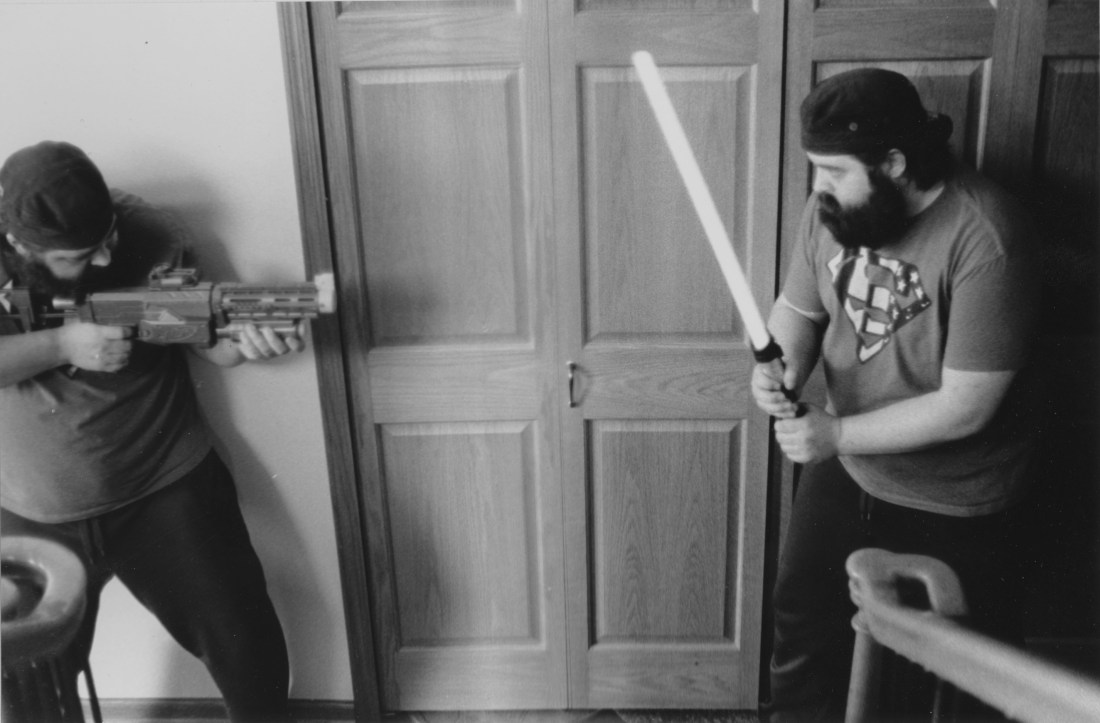
I knew that Photoshop could be used to merge photos, but there had to have been a process for doing so with older technology. For one project, I looked up that technology, and put it into effect. This adds a few steps to the process. For example, you need two enlargers. Make sure you ask if anyone needs enlargers before you start commandeering the entire Dark Room. Then, when you go to make the full image, you have to expose just part of it (in this case, left or right half). You do this with the advanced technology of A Piece of Cardstock Held Over the Paper. Make sure you feather the edge; otherwise, you can get a hard line that doesn’t look good. Now, line up the halfway exposed image on the other enlarger, hope you lined it up right because you can’t do any tests now, and expose the other side. Complete the process as normal.

And that’s how I made one photo of two of me. Tune in next time I do this, when I go through Self Portrait 2, which has over a dozen of me.

Delicious Beef: Morelli’s Italian Marketplace

(As I write this, I’m eating a delicious beef stick from Morelli’s. I’m not sure I can ever have Jack Links Beef Jerky again.)

A few weeks ago, I wrote about a Mexican market that had a restaurant inside. This is almost the exact opposite: an Italian market without a restaurant, but with a lot of alcohol.

Morelli’s opened in 1915, when you could sell food and alcohol without a fancy license. As their business continued, their business model turned more to alcohol, both imported and domestic. Since their business was so old, they were grandfathered into the new rules. Businesses now can’t sell alcohol and food in the same store (which is why Cub Foods here has a separate store-front for wine and spirits). As long as Morelli’s keeps selling food and alcohol, they can keep their unique business.

Inside, you are immediately aware of the meats. Like a bakery smells of fresh bread and a candy store smells of candy, this place smells like meat. There are sliced meats, big steaks, bulk ground beef (cheaper than the big grocery store, BTW), and tasty beef sticks (as I mentioned I am eating). Oh, and bacon. Breakfast is going to be good.

Besides the fresh meat counter, there’s not much other food. Various noodles, olive oil, and other Italian staples are available. There’s some Morelli’s brand spaghetti sauce, which I’m sure will be tasty as well. But then there’s the alcohol.

Morelli’s bills itself as “Discount Liquor”, and they aren’t kidding. There’s standard brands at good prices, but there’s also large boxes of $2 wine. It’s not quite the Costco of alcohol, but this is not the kind of place that would have wine tastings.

Overall, it’s not a place worth road-tripping to (unlike the various craft soda shops outside the Twin Cities), but if you live near Payne and Tedesco, I recommend getting some discount tasty meat or take-and-bake pizza.

Song of the Week for June 3, 2018

I can’t believe I’ve made it this far without using a Two Steps From Hell song. This group will come up again.

Song of the Week: Disappear by Two Steps From Hell

Two Steps From Hell is made up of Thomas Bergersen and Nick Phoenix. They produce music designed for use in trailers, movies, TV shows, and video games. Their first public album release was in 2010, and since then, they’ve released almost 1,000 unique tracks.

This isn’t my favorite song from TSFH, but it is the most timely. Some of their music really resonates with me, and I can visualize what a music video for the song would look like. For others, it’s Superman and an eagle flying together, or a blacksmith creating a magic sword (and you’ll hear about those, plus more, in future weeks). For Disappear, the video is my grandpa’s life flashing before his eyes as he dies in his sleep.

It starts with him on his bed, but he’s in a void of soft light. He gets up, moving slowly because of age and joint pain. There are open doors scattered throughout. As the music kicks in around 0:25, he opens the first door.

It reveals a freeze-frame that I will take from a photograph of him in WWII. As he watches, it springs to life, showing him with his squad. He watches for a moment, but doesn’t have time to reminisce.

From 0:25 to approaching 1:45, similar scenes play out. Him and his wife Katherine. Spending time with his children. Working on cars. He sees them, remembers them, but doesn’t spend the time to really remember.

But at the 1:45 mark, the music hangs in the air. Grandpa clutches at his heart. He realizes what’s happening.

The music is intense now. The doors start to close. He’s moving faster than before, as if his knees never had surgery, and his face is looking younger, but he can never catch more than a glimpse before each door is slammed in his face.

But after every other door has closed, there’s one more left. This is around 2:15, the second time through this “chorus”. Katherine is there, wrinkles and all, sitting in her living room chair. He runs to her, throwing his now middle-aged head in her lap. For a moment, she doesn’t move, but then she moves a hand and lifts his head. She’s smiling the same soft smile that our entire family remembers, and her face is noticeably younger. With her other hand, she wipes the tears from his eyes as she stands up. He follows her as she turns towards the bright light that has grown from off-camera.

At 2:42, when the final hits come, they take each other by the hand. Their faces are young, like in their early pictures. Together, they walk into eternity.

I don’t know if I’ll be able to actually make this before he dies. He’s not doing well right now, and Grandma really did die before him, so I’m not sure if he can make it without her. But he’s a tough trooper, so anything’s possible.

Tune in next week, where hopefully I won’t be crying while I write the post.

Types of Characters

Whether it’s playing games like Dungeons and Dragons, writing stories or movies, or simply appreciating books and movies already written, I’m a sucker for character development. I might go into more detail about each of these points in later posts, but I will attempt to lay out here some of the major character archetypes. And I mean “major”. These will be very broad, so they should apply to the media you are enjoying or creating.

Mary Sue/Gary Stu

I put the Mary Sue first because it is the pratfall of many a writer, myself included. Let me start with an example. When I started writing my superhero universe (which is in desperate need of a fifth or sixth rewrite), the main-est of the characters was born in my hometown, looked like me (except he was in shape), held a high position in the Boy Scouts that I had tried to obtain, was immediately made the leader of his team, and by the end of the first big story arc, was romantically attached to the attractive blonde teammate.

The term Mary Sue was coined 40 years ago, when a writer sent a story into a Star Trek magazine about Lieutenant Mary Sue, the youngest Star Fleet officer who could do no wrong. It now refers to a character who is unnaturally good at their position, and doesn’t have to work very hard to get to that position. This is bad character design, because that’s not how the real world works for most people. We want to see characters struggle and overcome, because that’s what we understand life to be about.

Many people say Rey from Star Wars 7 as a Mary Sue, since she kinda shortcuts all the usual Jedi training and just does it instead. Feel free to think upon that yourself instead of posting in the comments about how I’m a chauvinist because I don’t like a strong female lead.

Background characters

This is another pratfall of writers. Background characters are still characters, and sometimes need just as much development as the main characters. Example time!

In the Harry Potter books/movies, Harry Potter is the main character. We know that because the stories revolve around his actions, and because his name’s in the title. (Note that having your name in the title doesn’t make you the main character. See: The Legend of Zelda.) We understand Harry’s goals easily: he wants to be a wizard. He wants to win the Triwizard Tournament. He wants to not get killed by He Who Must Not Be Named.

But Harry isn’t the only character. He’s flanked by Ron and Hermione, opposed by Draco and Snape, and mentored by Dumbledore and Hagrid. Each of these characters has their own goals. Ron is trying to be unique among a giant family full of wizards. Hermione wants to prove that her ordinary parentage won’t stop her from succeeding. Draco spends all his time thinking he’s better than everyone else, and he’s mostly right. Snape’s motivations are difficult to nail down, but they’re definitely there. Dumbledore and Hagrid both want to see Harry succeed, from different angles.

What makes all these characters work in a series ostensibly about Harry Potter is how their goals align or contrast. Ron and Hermione ally themselves with Harry because they see each other as comrades in obscurity, who all have to work extra hard to achieve their own goals. Draco quickly learns that Harry is not to be messed with, which only makes him mess with Harry more to prove his own superiority. Snape has history with Harry, and works very hard to make sure he will be there for him when the time comes. And Dumbledore and Hagrid are giant softies who want to see everyone succeed.

Give background characters goals, figure out how they work with the main character’s goals, and you will have much more compelling characters.

People who are Too Cool

Switching gears back to characters that are Not Good, beware of characters who have room to grow, but start out with too much character development. This limits how far the character can actually grow before you have to expand your world to make room for the character.

Two good examples of this are Superman and the recent Call of Duty games as wholes. Superman, in his early days, just did basic superhuman things. High jump, immune to bullets, hears really good. Nowadays, he’s practically invincible. It’s hard to find a challenge for Superman to overcome, because he’s so powerful. Yes, such threats exist, but they aren’t on the scale that normal people could possibly mirror in their life.

Call of Duty 4: Modern Warfare was a good game. The story was a bit bombastic, but it made sense. The most recent “modern” installment, Infinite Warfare, opens with one character single-handedly storming a space station, killing basically everyone before being taken out by the big bad guy. If that’s the opening scene, escalation from there is difficult.

That’s not to say that starting big can’t work. It’s all a matter of context and scale. In Saints Row 4, Earth is destroyed within the first hour of play. However, since the context of the game has galactic proportions, Earth is actually pretty small on the scale. It’s only a big deal to us because we live on Earth.

OK, that’s enough typing for today. Later, I’ll either dive deeper into one of these, or come up with some more archetypes to talk about.

A Vision of Peace

It’s not often you have to pass through a metal detector to see art. Maybe I’m just used to the MIA having lax security. But the Vision of Peace is worth seeing, even if you have to concede to underpaid security officer’s requests.

Inside the Ramsey County office (where I have been for jury duty, but I wasn’t paying attention then), a massive white onyx statue stands. It’s made of over 30 pieces of stone that were carved individually, then assembled. It depicts five Native Americans smoking pipes, their smoke rising to form a larger figure. It’s not the most detailed sculpture in the world, but it is the largest onyx sculpture.

There’s more to it than just being large. It actually oscillates back and forth over the course of a day. Every 2.5 hours, it completes its rotating and does another cycle. This serves a few purposes. First, you’d never be able to see the detail work on the back otherwise. Second, this allows the statue to “see out” farther, casting its gaze over a wider area.

The statue was unveiled on May 28, 1936, so yesterday was the 82nd anniversary. But that’s not the only cool artistic thing to see in the county office.

The building itself is interesting. Designed during the Art Deco period, a lot of the functional parts of the building are more art than function or decoration. The elevator doors are almost sculptures, the lights are angular instead of round, the ceiling in the lobby is reflective (making the statue look even better).

In the basement, there’s a bit of history, including the history of the sculpture and the building. There’s also a piece of the 35W bridge that collapsed, which is important to remember, but a little weird to have on display.

Parking is available at curb-side, and it doesn’t take more than 20 minutes to see the sights.

Song of the Week for May 27, 2018

As promised, a Muse song.

Song of the Week: Knights of Cydonia by Muse (warning: it’s the oddest spaghetti Western you’ve ever seen)

You may have heard of this song, either from Guitar Hero or because it’s one of Muse’s top songs. Muse has been putting together uncomplicated complex looks into intense lines of thought for over a decade. When I say “uncomplicated”, I don’t mean “easy to play”. There’s a reason this song is on the hard end of Guitar Hero songs. It’s uncomplicated because the music never gets in the way of the words, and vice versa. It’s easy to find the beat, easy to keep the beat, and easy to hear the words. And the words are important.

Muse probably call themselves visionaries. A lot of people probably call them weird. As an artist, I can appreciate both sentiments. This music video is not normal. Even at the start, when the cowboy is practicing martial arts, we know something is up. Then there’s a laser gun. Then there’s a car. Then there’s holographic singers. And if you thought you saw a robot in the opening minute, don’t worry, he comes back. But there’s a story there. The setting is odd, but the story itself is cohesive.

And the song is along Muse’s main theme: fighting for your rights. It’s not quite the same as My Chemical Romance or System of a Down, whose music sounds a bit more…forceful. Muse presents fighting for your rights as a normal part of life, not a difficult uphill task. Part of life is working to maintain your status. This is normal, but this is worth talking about.

Also, Knight of Cydonia has some rad guitar work. Bang your head!

Storytelling with Cardstock 2

Told you we’d be back here. It’s time to take another look at how Magic: the Gathering uses the entire trading card to tell a story. This time, we’ll be looking at two (or more) cards that together tell a single part of a story.

For my introduction to the game of Magic and the parts of a card, you can check out Storytelling with Cardstock 1.

I was reminded of this topic from a Magic podcast that ended up on the topic of the card Grapple with the Past. I’m not linking that card yet, because to truly understand the story, you have to start with Make a Wish. The story of this single card is that wishes are frowned upon, but still happen. The card itself allows you to gain back cards that were once discarded, so the function matches the flavor.

If you read Part 1, you know that I looked exclusively at the world of Innistrad. Make a Wish is from that world, at a time when, creatively, the Magic team didn’t know there would be a return. But return they did, and that’s when some genius decided to make Grapple with the Past. For full effect, I’ll put the two images next to each other.

Make a WishGrapple with the Past

The same artist drew both cards. Years apart, a story once thought over is continued. And that wouldn’t be the last example of past-and-present storytelling in Innistrad.

Endless Ranks of the DeadRelentless Dead

First, the zombies were encroaching on the church. Now, the zombies are in, and they aren’t going to go away. (The same artist drew these two cards. Different than the last artist.)

Moving away from Innistrad, let’s take a journey over to Tarkir. Tarkir was inspired by Asian cultures: nomadic Monguls, Tibetan monks, etc. It is also a land of dragons, but not at first. The dragons have all gone, and Sarkhan, a hometown boy finally returned home, doesn’t like the lack of dragons. He goes back in time and changes the timeline so that dragons are alive in the present. There’s a lot of timeline-vs-timeline storytelling here, but the best example is Summit Prowler, the monster that’s the same in both timelines.

Summit ProwlerSummit Prowler

The dragons are back, and with them, a change in perception for the poor summit prowler. In the first timeline, they were feared. In the second, they are a tasty snack.

Here’s one more, and it’s a doozy. Magic’s favorite villain currently is Nicol Bolas, and I’ll do a full work-up of his story one day. Recently, a group of main characters ignored good advice and confronted him. The end of that story is a series of five cards named So-and-So’s Defeat.

Gideon's DefeatJace's DefeatLiliana's DefeatChandra's DefeatNissa's Defeat

Clearly, the five of them didn’t do very well. But if you look carefully, one of them is different. Can you spot it? Scroll down for the answer.


The third one, Liliana, is different. Of all five, she still holds her purple energy power in her hand, and she’s not being actively defeated. In the story, her defeat is not physical or emotional, but transitional. Nicol Bolas, instead of destroying her, basically says, “Remember how I kicked your butt before? How about you owe me a favor” and lets her leave. He hasn’t called in that favor yet, but I don’t think it will go well.

There’s more storytelling in the cards, but not as much multi-card storytelling. Usually, it’s just pieces of a big story, not interconnected pieces. I think the next Storytelling in Cardstock will have to be single cards with my favorite art.